Athlete's Foot

A fungal skin infection of the foot

Athlete's foot is a contagious fungal infection of the skin between the toes and on the soles, treatable with topical antifungals and footwear hygiene. Same-day or next-day evaluations across eight LA-area offices.

Los Angeles orthopedic specialist evaluating a patient for athlete's foot. LAOSS board-certified care across eight LA offices

See a specialist this week

Board-certified surgeons and podiatrists across eight Los Angeles area neighborhoods.

Book a visitOr call (323) 264-7600

Common foot & ankle concerns we treat

  • Pain that limits walking, lifting, or sleep
  • Stiffness, swelling, or reduced range of motion
  • Sports injuries: acute or overuse
  • Arthritis or post-traumatic joint changes
  • Conditions other doctors couldn't resolve

What sets LAOSS apart

  • Same- or next-day appointments at eight Los Angeles-area offices
  • On-site imaging; PT coordinated with your in-network provider
  • Conservative-first care, surgery only when needed
  • Board-certified specialists, not generalists

Key takeaways

  • Athlete's foot is one of many foot & ankle conditions our specialists evaluate every day.
  • Most cases clear with topical antifungal medication plus simple hygiene changes: keeping feet dry, rotating shoes, changing socks daily.
  • Stubborn, widespread, or recurrent infections usually respond to prescription-strength topical or oral antifungals from our podiatry team.
  • Same-day appointments across eight Los Angeles-area locations.

What is athlete's foot?

Athlete's foot is a contagious fungal infection of the skin between the toes and on the soles, treatable with topical antifungals and footwear hygiene. It often starts between the toes and, without treatment, can spread to the soles and toenails.

Most cases of athlete's foot clear with topical antifungal medication combined with simple hygiene measures: keeping the feet dry, rotating shoes so each pair dries out, and changing socks daily. When the infection is widespread, keeps coming back, or doesn't respond to over-the-counter creams, our podiatrists can prescribe stronger topical or oral antifungals and rule out look-alike conditions such as eczema or psoriasis.

Below, we walk through the anatomy involved, the symptoms and causes we most often see, how we diagnose athlete's foot, and the full range of treatment options, from the simplest to the most involved.
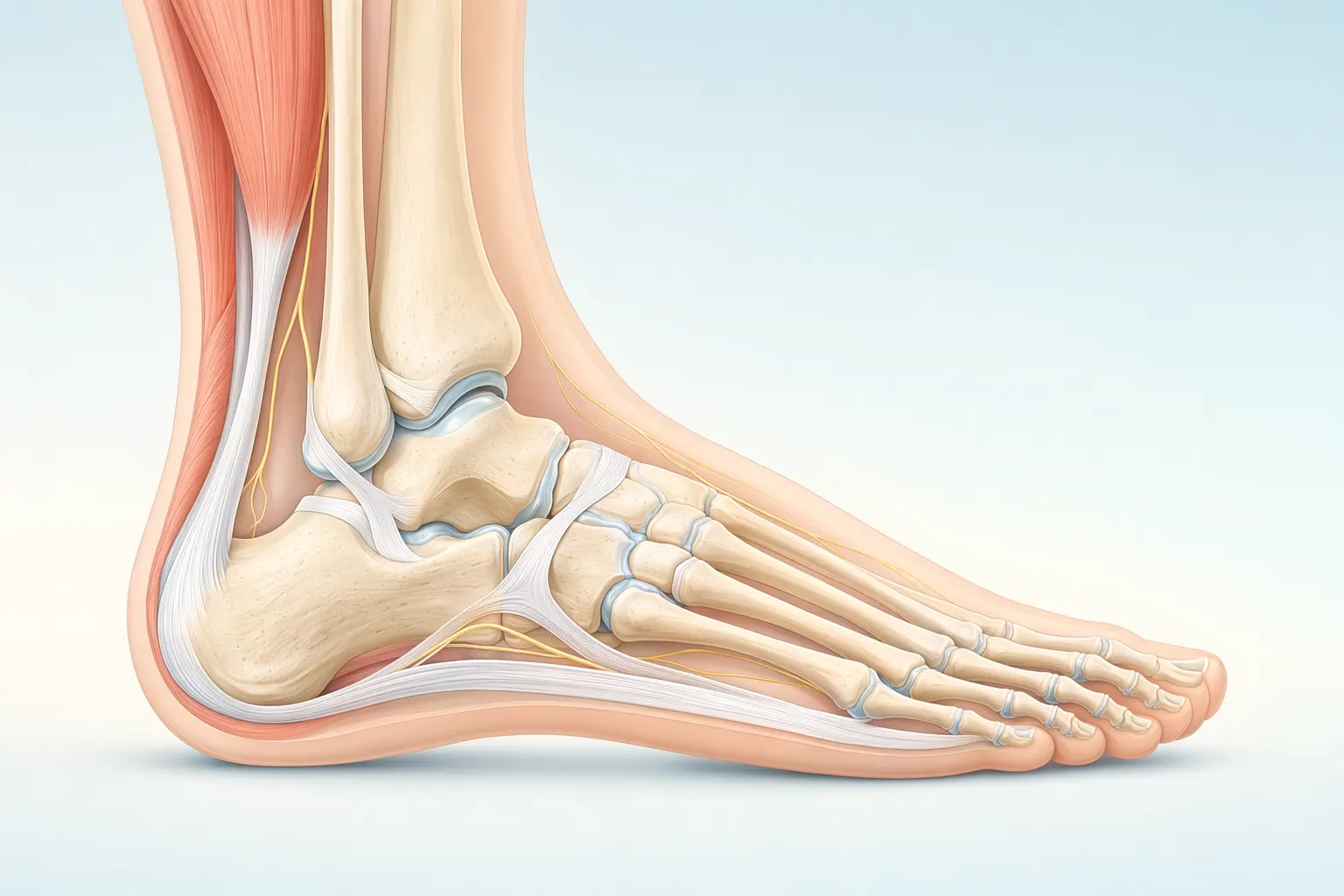
Anatomical illustration of the foot and ankle showing the tibia, talus, calcaneus, and plantar fascia
Anatomy of the foot & ankle: tibia, talus, calcaneus, metatarsals, and the plantar fascia.

Inside the foot & ankle.

The foot and ankle have 26 bones, more than 30 joints, and over 100 ligaments and tendons. The plantar fascia spans the bottom of the foot, the Achilles tendon anchors the calf to the heel, and the ankle is a hinge that handles every step you take. Most foot and ankle problems trace back to overload, alignment, or footwear that doesn't match the way your foot is built.

Symptoms and causes of athlete's foot

Common symptoms

  • Itching and burning between the toes
  • Cracked, peeling skin on the soles
  • Redness and scaling
  • Blisters in severe cases

Common causes

  • Exposure in communal wet areas
  • Sweaty shoes and socks
  • Compromised skin barrier
  • Spreads from fungal nails

How we diagnose athlete's foot

You want answers, fast, and we're built to give them. Most patients leave their first LAOSS visit with a clear diagnosis and a written plan, not another referral chain.

Here's what your initial visit for athlete's foot typically looks like:

  • Detailed history: when it started, what makes it better or worse, what you've already tried
  • Skin examination of the feet and toenails, sometimes with a quick skin scraping (KOH test) to confirm the fungus and rule out look-alike rashes
  • A written plan covering medication, hygiene, and prevention, in plain English

Schedule your evaluation at the LAOSS office nearest you.

How we treat athlete's foot at LAOSS

Once we've confirmed the diagnosis, the next step is matching the right treatment to your situation. We start with the least-invasive option that fits, and escalate only when it doesn't.

Conservative care
Step 1

Over-the-counter & self-care

Most athlete's foot clears within a few weeks of consistent antifungal treatment and dry, breathable footwear.

  • Topical antifungal creams or sprays (terbinafine, clotrimazole)
  • Keep feet clean and thoroughly dry, especially between the toes
  • Change socks daily; choose moisture-wicking materials
  • Rotate shoes so each pair dries out between wears
  • Sandals in communal showers, locker rooms, and pool decks
Surgical care
When needed

Prescription care for stubborn cases

When over-the-counter treatment fails, the infection is extensive, or you have diabetes, our podiatrists step in.

  • Prescription-strength topical antifungals
  • Oral antifungal medication for extensive or recurrent infection
  • Treatment of co-existing fungal toenail infection that reseeds the skin
  • Evaluation to rule out eczema, psoriasis, and bacterial infection
  • Preventive foot-care planning for patients with diabetes

Why experience matters.

Why experience matters

Foot & ankle care is highly technique-dependent. Volume, training, and judgment together determine the outcome you actually feel six months later.

  • Precise diagnosis from imaging and exam
  • Conservative-first care that avoids unnecessary surgery
  • Surgical technique refined over thousands of cases
  • On-site imaging + coordinated PT through your in-network provider

The LAOSS approach

Our foot & ankle specialists move stepwise: start with the least-invasive option that fits your situation, escalate only when it doesn't.

  • Same-day imaging at most offices
  • PT coordinated in your insurance network
  • Board-certified surgeons performing the procedures themselves
  • Direct access to your specialist between visits

Am I a candidate?

If most of these match your situation, an evaluation with a foot & ankle specialist is the next step.

You may be

You may be a candidate if

These signs typically point toward an in-person evaluation with a foot & ankle specialist.

  • An itchy, burning, or peeling rash between the toes or on the soles
  • A rash that has not cleared with over-the-counter antifungal treatment
  • An infection that keeps coming back or is spreading
  • Previous treatment that didn't fully resolve the problem
  • Diabetes, poor circulation, or a weakened immune system along with any foot infection
Evaluation

What evaluation includes

Your first visit is built to give you an answer the same day, not just another referral.

  • Detailed history: onset, mechanism, what makes it better or worse
  • Skin examination of the feet and toenails
  • Skin scraping (KOH test) when the diagnosis is not clear
  • Clear plan covering medication, hygiene, and prevention
  • Same-day or next-day scheduling for any follow-up tests

ImportantSeek urgent evaluation for signs of a bacterial infection: spreading redness, swelling, warmth, pus, or fever. If you have diabetes or poor circulation, have any foot infection checked promptly instead of treating it yourself.

Your foot & ankle recovery roadmap.

Recovery is rarely a straight line, but a clear plan with measurable milestones makes the path predictable.

  1. Days 0 to 14

    Starting treatment

    In the first two weeks the goal is to use the antifungal medication exactly as directed and keep the feet dry.

    • Antifungal cream or spray applied as directed, including between the toes
    • Feet washed and dried thoroughly every day
    • Clean socks daily, and shoes rotated so each pair dries out
    • Follow-up if the rash is not improving
  2. Weeks 2 to 8

    Clearing the infection

    Itching and scaling usually ease first. Finishing the full course of treatment, even after the skin looks better, lowers the chance that the infection returns.

    • Full course of medication finished, even once the skin looks clear
    • Prescription topical or oral antifungal if over-the-counter treatment has not worked
    • Fungal toenails checked and treated so they do not reinfect the skin
    • Socks, towels, and bath mats washed regularly
  3. Months 2+

    Preventing recurrence

    Once the skin has cleared, the focus shifts to keeping the infection from coming back.

    • Sandals in communal showers, locker rooms, and pool areas
    • Moisture-wicking socks and breathable shoes
    • Feet dried well after bathing, especially between the toes
    • Direct line back to your specialist if needed
Risks & considerations

What to weigh before you decide.

We talk through the risks and benefits with every patient. Informed consent is a conversation, not a form.

General

General considerations

Antifungal treatment is generally safe, but every medication has trade-offs. We review these with you before prescribing.

  • Mild skin irritation, burning, or redness from topical antifungals
  • Possible interactions between oral antifungals and other medications
  • Rare liver effects from oral antifungals, which is why blood tests are sometimes ordered
  • Return of the infection if treatment is stopped too early
Specific

If athlete's foot is left untreated

Some risks come from the infection itself, especially when it goes untreated.

  • Spread to the toenails, hands, or groin
  • Cracked skin that lets bacteria in and can lead to a deeper skin infection (cellulitis)
  • Higher risk of complications for people with diabetes or poor circulation
  • Spread to family members through shared floors, towels, or shoes

Meet our foot & ankle doctors in the Greater Los Angeles area

At LAOSS, our foot & ankle specialists are board-certified and treat these problems every day. From minimally invasive arthroscopic techniques to joint replacement and arthritis management, our physicians bring decades of experience to every case. We have cared for Los Angeles patients since 2007, with one goal for each: less pain, better movement, and a return to the activities you love.

Meet your foot & ankle specialists.

View all providers
Compare up to 34 providers
  • Accepting new patients

    Danny Wang, DPM

    Podiatrist

    • Santa Fe Springs
    • East Los Angeles
  • Accepting new patients

    Michael Marcus, DPM

    Podiatrist

    • Santa Fe Springs
  • Accepting new patients

    Matt Cikra, DPM

    Podiatrist

    • Wilshire
    • Santa Fe Springs
    • Tarzana
    • +1 more
  • Accepting new patients

    Yixi Lu, DPM

    Podiatrist

    • Valencia
    • Tarzana
    • East Los Angeles

Care for athlete's foot starts here

Don't let athlete's foot be something you just power through. With same- or next-day appointments at multiple Los Angeles locations, you'll never wait weeks or months for answers. The same team handles your diagnosis, treatment, and recovery. From confirming the diagnosis to clearing the infection and preventing recurrence, we plan it with you and coordinate each step.

Call or schedule online today to see a foot & ankle specialist in Los Angeles.

Find care by body area.

Jump to a nearby condition page and compare treatment paths across the body.

Common athlete's foot questions

  • Athlete's foot is usually diagnosed by examining the skin. When the picture isn't clear, a quick skin scraping (KOH test) confirms the fungus and rules out look-alikes such as eczema or psoriasis, no X-rays or MRI needed. Most patients leave the first visit with a clear diagnosis and a written plan.

Don't wait on pain.

Book a visit with a foot & ankle specialist at any of our eight Los Angeles-area offices.

Booking now
21 specialists · 8 offices
Greater Los Angeles
On-site X-raySame visit
Most insurers acceptedIn-network
Triage chat · AI assisted

Los Angeles Orthopedic Surgery Specialists

You are chatting with an AI assistant, not a doctor or nurse. Messages are processed by Microsoft Azure and sent to our care team by email, so share only what you are comfortable sharing. To talk with a person, call (323) 264-7600. Privacy policy

Assistant: Hi, I'm an AI assistant for Los Angeles Orthopedic Surgery Specialists. I'm not a doctor and can't give medical advice. If this is an emergency, call 911 or go to the nearest ER. Anything you share will go to a LAOSS team member who'll reach out to schedule your visit. What's bothering you today?
The assistant is answering. You can keep typing.

Book a visit

Pick a time online, or leave your details and a team member will call you within 1 business day.

Pick a time online

Opens Zocdoc in a new tab

A phone number or an email is enough.

Or call (323) 264-7600