Common foot & ankle concerns we treat
- Pain that limits walking, lifting, or sleep
- Stiffness, swelling, or reduced range of motion
- Sports injuries: acute or overuse
- Arthritis or post-traumatic joint changes
- Conditions other doctors couldn't resolve
Bone and joint breakdown from nerve damage
Charcot foot is a serious complication of diabetes where the bones of the foot weaken, fracture, and collapse, usually without the patient feeling pain due to underlying neuropathy. Same-day or next-day evaluations across eight LA-area offices.

Board-certified surgeons and podiatrists across eight Los Angeles area neighborhoods.
Key takeaways
Charcot foot is a serious complication of diabetes where the bones of the foot weaken, fracture, and collapse, usually without the patient feeling pain due to underlying neuropathy. It often starts as a warm, red, swollen foot, sometimes after a minor injury you may not have felt. Early Charcot foot is easily mistaken for an infection or a sprain, so prompt evaluation matters.
Early Charcot foot is treated with strict offloading and immobilization: most often a total contact cast, changed regularly while the bones consolidate, followed by a custom brace (such as a CROW boot) and protective footwear. This phase can take months, and protecting the foot through it is what prevents collapse and deformity. Surgery (removing a bony prominence or reconstructing the arch) is reserved for feet left unstable or deformed enough to cause ulcers or make bracing impossible.
Below, we walk through the anatomy involved, the symptoms and causes we most often see, how we diagnose Charcot foot, and the full range of treatment options, from the simplest to the most involved.
This form of foot damage involves the bones and joints. Over time, it can cause the foot to collapse. This leads to severe problems.
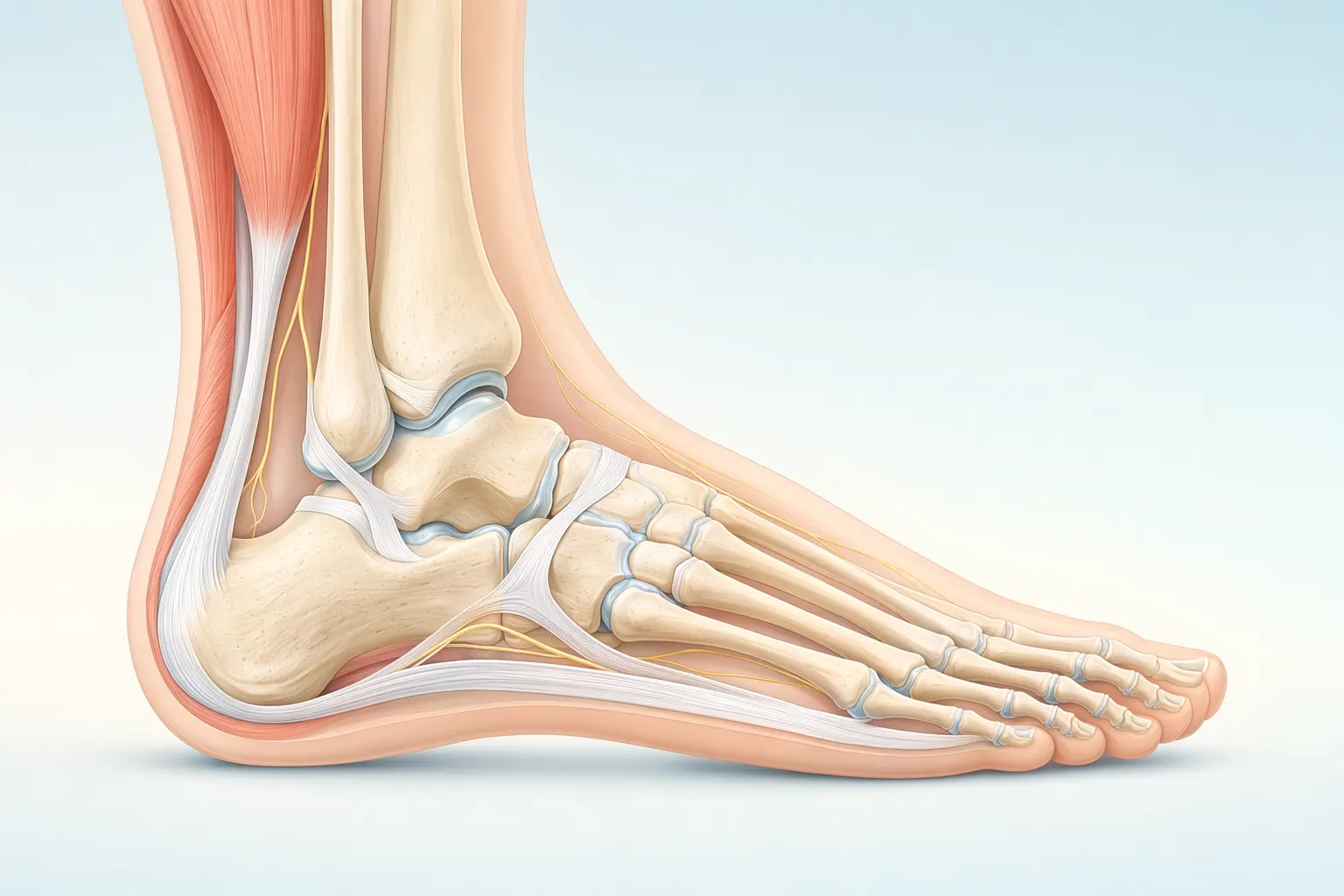
The foot and ankle have 26 bones, more than 30 joints, and over 100 ligaments and tendons. The plantar fascia spans the bottom of the foot, the Achilles tendon anchors the calf to the heel, and the ankle is a hinge that handles every step you take. Most foot and ankle problems trace back to overload, alignment, or footwear that doesn't match the way your foot is built.
You want answers, fast, and we're built to give them. Most patients leave their first LAOSS visit with a clear diagnosis and a written plan, not another referral chain.
Here's what your initial visit for Charcot foot typically looks like:
Schedule your evaluation at the LAOSS office nearest you.
Once we've confirmed the diagnosis, the next step is matching the right treatment to your situation. We start with the least-invasive option that fits, and escalate only when it doesn't.
Protecting the foot while the bones consolidate is the heart of Charcot treatment.
For feet left unstable, deformed, or repeatedly ulcerating despite bracing.
Foot & ankle care is highly technique-dependent. Volume, training, and judgment together determine the outcome you actually feel six months later.
Our foot & ankle specialists move stepwise: start with the least-invasive option that fits your situation, escalate only when it doesn't.
If most of these match your situation, an evaluation with a foot & ankle specialist is the next step.
These signs typically point toward an in-person evaluation with a foot & ankle specialist.
Your first visit is built to give you an answer the same day, not just another referral.
ImportantSeek urgent evaluation for a newly swollen, warm, or red foot if you have diabetes or neuropathy, an open sore or wound, a sudden change in the shape of the foot, or any sign of infection (fever, spreading redness, or drainage).
Recovery is rarely a straight line, but a clear plan with measurable milestones makes the path predictable.
In the first two weeks we focus on taking weight off the foot and immobilizing it, usually in a total contact cast, to stop further damage.
The cast is changed regularly while swelling and warmth settle and the bones consolidate. This phase usually lasts months, not weeks.
Once the foot is stable, you move into a custom brace such as a CROW boot and then protective footwear, with lifelong monitoring to catch flare-ups early.
We talk through the risks and benefits with every patient. Informed consent is a conversation, not a form.
Every orthopedic intervention carries a small set of standard risks. We screen, prepare, and monitor for these on every patient.
Some risks are tied to the structures we're treating in the foot & ankle. We discuss these in detail at your visit so you can weigh them against the benefits.
At LAOSS, our foot & ankle specialists are board-certified and treat these problems every day. From minimally invasive arthroscopic techniques to joint replacement and arthritis management, our physicians bring decades of experience to every case. We have cared for Los Angeles patients since 2007, with one goal for each: less pain, better movement, and a return to the activities you love.
Don't let Charcot foot be something you just power through. With same- or next-day appointments at multiple Los Angeles locations, you'll never wait weeks or months for answers. The same team handles your diagnosis, treatment, and recovery. Whether you need total contact casting, custom bracing, or reconstructive surgery, we plan it with you and coordinate each step.
Call or schedule online today to see a foot & ankle specialist in Los Angeles.
Book a visit with a foot & ankle specialist at any of our eight Los Angeles-area offices.