Chronic Ankle Instability

An ankle that keeps giving way

Chronic ankle instability develops after inadequately rehabilitated ankle sprains, producing recurrent giving-way episodes and a persistently unstable feeling. Same-day or next-day evaluations across eight LA-area offices.

Los Angeles orthopedic specialist evaluating a patient for chronic ankle instability: LAOSS board-certified care across eight LA offices

See a specialist this week

Board-certified surgeons and podiatrists across eight Los Angeles area neighborhoods.

Book a visitOr call (323) 264-7600

Common foot & ankle concerns we treat

  • Pain that limits walking, lifting, or sleep
  • Stiffness, swelling, or reduced range of motion
  • Sports injuries: acute or overuse
  • Arthritis or post-traumatic joint changes
  • Conditions other doctors couldn't resolve

What sets LAOSS apart

  • Same- or next-day appointments at eight Los Angeles-area offices
  • On-site imaging; PT coordinated with your in-network provider
  • Conservative-first care, surgery only when needed
  • Board-certified specialists, not generalists

Key takeaways

  • Chronic ankle instability is one of many foot & ankle conditions our specialists evaluate every day.
  • Most patients improve with conservative care: balance and strengthening therapy with your in-network PT, plus an ankle brace or taping for sports and uneven ground.
  • When a procedure is the right call, we explain every option, recovery timeline, and return-to-activity milestone.
  • On-site imaging at most offices and same-day appointments across eight Los Angeles-area locations.

What is chronic ankle instability?

Chronic ankle instability develops after inadequately rehabilitated ankle sprains, producing recurrent giving-way episodes and a persistently unstable feeling. Symptoms can develop gradually or after a specific injury, so early evaluation matters when function starts to decline.

Most patients with chronic ankle instability improve with conservative care: physical therapy focused on balance and peroneal strength, an ankle brace or taping for sports and uneven ground, and supportive footwear. When the ankle keeps giving way after a full course of rehabilitation, our specialists offer the ligament repair and reconstruction procedures discussed below.

Below, we walk through the anatomy involved, the symptoms and causes we most often see, how we diagnose chronic ankle instability, and the full range of treatment options, from the simplest to the most involved.

Watch: Chronic Lateral Ankle Pain

This is a pain on the outer side of your ankle. It's a lasting pain that you may feel all the time. It can make it hard for you to walk and run, and it can increase the possibility of ankle sprains.
Animations licensed from ViewMedica · Swarm Interactive
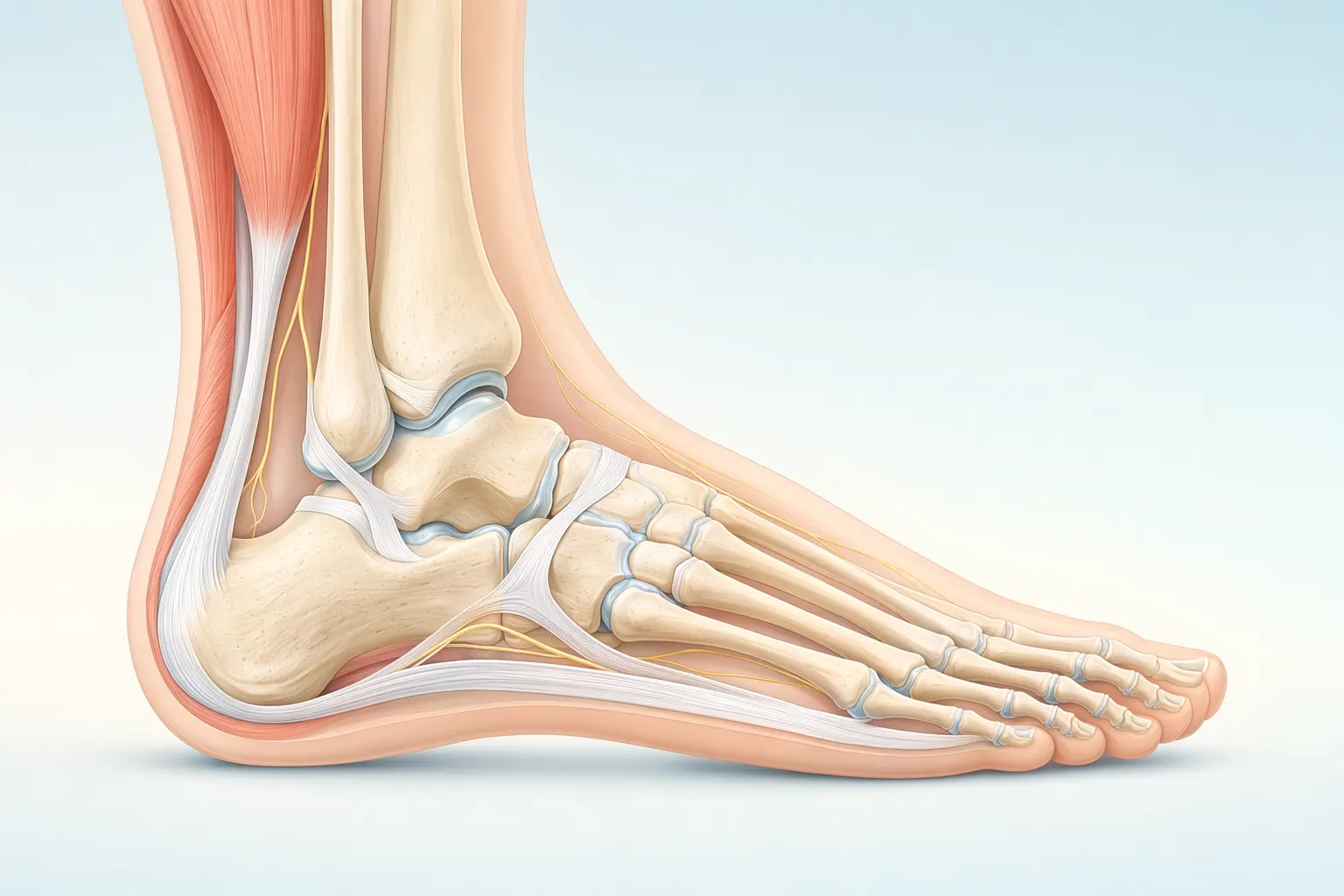
Anatomical illustration of the foot and ankle showing the tibia, talus, calcaneus, and plantar fascia
Anatomy of the foot & ankle: tibia, talus, calcaneus, metatarsals, and the plantar fascia.

Inside the foot & ankle.

The foot and ankle have 26 bones, more than 30 joints, and over 100 ligaments and tendons. The plantar fascia spans the bottom of the foot, the Achilles tendon anchors the calf to the heel, and the ankle is a hinge that handles every step you take. Most foot and ankle problems trace back to overload, alignment, or footwear that doesn't match the way your foot is built.

Symptoms and causes of chronic ankle instability

Common symptoms

  • Repeated ankle rolling, even on flat ground
  • A persistent unstable feeling
  • Recurrent pain and swelling after activity
  • Avoidance of uneven terrain

Common causes

  • Inadequately rehabilitated ankle sprains
  • Damaged peroneal tendons
  • Stretched ankle ligaments
  • Reduced proprioception after injury

How we diagnose chronic ankle instability

You want answers, fast, and we're built to give them. Most patients leave their first LAOSS visit with a clear diagnosis and a written plan, not another referral chain.

Here's what your initial visit for chronic ankle instability typically looks like:

  • Detailed history: when it started, what makes it better or worse, what you've already tried
  • Focused exam of the foot & ankle: range of motion, stability, strength, specific provocation tests
  • On-site imaging at most offices: X-ray for bone, ultrasound or MRI when soft-tissue detail is needed
  • A written plan with options ranging from conservative care to surgical procedures, in plain English

Schedule your evaluation at the LAOSS office nearest you.

How we treat chronic ankle instability at LAOSS

Once we've confirmed the diagnosis, the next step is matching the right treatment to your situation. We start with the least-invasive option that fits, and escalate only when it doesn't.

Conservative care
Step 1

Conservative care first

Non-surgical options designed to relieve pain, restore movement, and avoid the OR when possible.

  • Physical therapy focused on balance and proprioception training
  • Strengthening of the peroneal muscles on the outside of the ankle
  • Lace-up or semi-rigid ankle brace, or taping, for sports and uneven ground
  • Supportive footwear, and orthotics when foot shape contributes
  • Activity changes while strength and balance are rebuilt
Surgical care
When needed

Surgical options when needed

Minimally invasive and reconstructive procedures performed by board-certified orthopedic surgeons.

  • Lateral ankle ligament repair (Brostrom procedure)
  • Ligament reconstruction with a tendon graft when the tissue is too worn to repair
  • Suture-tape (internal brace) reinforcement of the repair in selected cases
  • Ankle arthroscopy to treat cartilage damage, scar tissue, or loose fragments at the same time
  • Peroneal tendon repair when a tendon tear is part of the problem
  • Heel realignment (calcaneal osteotomy) when a high-arched, inward-tilted heel is driving the sprains

Why experience matters.

Why experience matters

Foot & ankle care is highly technique-dependent. Volume, training, and judgment together determine the outcome you actually feel six months later.

  • Precise diagnosis from imaging and exam
  • Conservative-first care that avoids unnecessary surgery
  • Surgical technique refined over thousands of cases
  • On-site imaging + coordinated PT through your in-network provider

The LAOSS approach

Our foot & ankle specialists move stepwise: start with the least-invasive option that fits your situation, escalate only when it doesn't.

  • Same-day imaging at most offices
  • PT coordinated in your insurance network
  • Board-certified surgeons performing the procedures themselves
  • Direct access to your specialist between visits

Am I a candidate?

If most of these match your situation, an evaluation with a foot & ankle specialist is the next step.

You may be

You may be a candidate if

These signs typically point toward an in-person evaluation with a foot & ankle specialist.

  • Pain or stiffness in the foot & ankle that lasts more than a few days
  • Swelling, instability, or noticeable change in function
  • Symptoms that limit walking, lifting, sleep, or work
  • Previous treatment that didn't fully resolve the problem
  • Imaging or exam findings that suggest an underlying issue
Evaluation

What evaluation includes

Your first visit is built to give you an answer the same day, not just another referral.

  • Detailed history: onset, mechanism, what makes it better or worse
  • Hands-on exam focused on the affected joint or region
  • On-site imaging at most offices (X-ray, ultrasound)
  • Clear plan with options ranging from conservative to surgical
  • Same-day or next-day scheduling for any follow-up tests

ImportantSeek urgent evaluation for sudden severe pain, numbness, progressive weakness, or any sign of infection (fever, increasing redness or swelling).

Your foot & ankle recovery roadmap.

Recovery is rarely a straight line, but a clear plan with measurable milestones makes the path predictable.

  1. Days 0 to 14

    Right after care

    In the first two weeks we focus on protecting the foot & ankle, calming inflammation, and restoring basic motion.

    • Activity modification with clear do/don't guidance
    • Ice, elevation, and pain control as needed
    • Gentle range-of-motion within safe limits
    • Follow-up scheduled to track healing
  2. Weeks 2 to 8

    Rehabilitation

    Targeted physical therapy rebuilds strength, mobility, and confidence in the foot & ankle.

    • Progressive strengthening and neuromuscular work
    • Manual therapy and soft-tissue treatment
    • Sport- or job-specific movement re-training
    • Coordinated PT through your in-network provider
  3. Months 2+

    Long-term care

    Once function is restored, the focus shifts to keeping you there, and catching any recurrence early.

    • Return-to-activity plan with measured benchmarks
    • Home program tailored to your sport or job
    • Maintenance visits or imaging if symptoms change
    • Direct line back to your specialist if needed
Risks & considerations

What to weigh before you decide.

We talk through the risks and benefits with every patient. Informed consent is a conversation, not a form.

General

General considerations

Every orthopedic intervention carries a small set of standard risks. We screen, prepare, and monitor for these on every patient.

  • Infection (rare with modern technique and prophylaxis)
  • Bleeding or bruising at the treatment site
  • Reaction to anesthesia or medications
  • Need for additional procedures in some cases
Specific

Foot and ankle considerations

Some risks are tied to the structures we're treating in the foot & ankle. We discuss these in detail at your visit so you can weigh them against the benefits.

  • Temporary stiffness or weakness during recovery
  • Incomplete pain relief in a small percentage of cases
  • Nerve or vessel irritation near the treatment area
  • Need for follow-up therapy to fully restore function

Meet our foot & ankle doctors in the Greater Los Angeles area

At LAOSS, our foot & ankle specialists are board-certified and treat these problems every day. From minimally invasive arthroscopic techniques to joint replacement and arthritis management, our physicians bring decades of experience to every case. We have cared for Los Angeles patients since 2007, with one goal for each: less pain, better movement, and a return to the activities you love.

Meet your foot & ankle specialists.

View all providers
Compare up to 34 providers
  • Accepting new patients

    Danny Wang, DPM

    Podiatrist

    • Santa Fe Springs
    • East Los Angeles
  • Accepting new patients

    Michael Marcus, DPM

    Podiatrist

    • Santa Fe Springs
  • Accepting new patients

    Matt Cikra, DPM

    Podiatrist

    • Wilshire
    • Santa Fe Springs
    • Tarzana
    • +1 more
  • Accepting new patients

    Yixi Lu, DPM

    Podiatrist

    • Valencia
    • Tarzana
    • East Los Angeles

Care for chronic ankle instability starts here

Don't let chronic ankle instability be something you just power through. With same- or next-day appointments at multiple Los Angeles locations, you'll never wait weeks or months for answers. The same team handles your diagnosis, treatment, and recovery. Whether you need physical therapy, injections, or surgery, we plan it with you and coordinate each step.

Call or schedule online today to see a foot & ankle specialist in Los Angeles.

Find care by body area.

Jump to a nearby condition page and compare treatment paths across the body.

Common chronic ankle instability questions

  • We start with a focused orthopedic exam and detailed history. X-rays are usually done in-office; MRI or ultrasound is ordered when soft-tissue detail is needed. Most patients leave the first visit with a clear diagnosis and a written plan.

Don't wait on pain.

Book a visit with a foot & ankle specialist at any of our eight Los Angeles-area offices.

Booking now
21 specialists · 8 offices
Greater Los Angeles
On-site X-raySame visit
Most insurers acceptedIn-network
Triage chat · AI assisted

Los Angeles Orthopedic Surgery Specialists

You are chatting with an AI assistant, not a doctor or nurse. Messages are processed by Microsoft Azure and sent to our care team by email, so share only what you are comfortable sharing. To talk with a person, call (323) 264-7600. Privacy policy

Assistant: Hi, I'm an AI assistant for Los Angeles Orthopedic Surgery Specialists. I'm not a doctor and can't give medical advice. If this is an emergency, call 911 or go to the nearest ER. Anything you share will go to a LAOSS team member who'll reach out to schedule your visit. What's bothering you today?
The assistant is answering. You can keep typing.

Book a visit

Pick a time online, or leave your details and a team member will call you within 1 business day.

Pick a time online

Opens Zocdoc in a new tab

A phone number or an email is enough.

Or call (323) 264-7600